Showing posts with label culture. Show all posts

Monday, 28 May 2007

US vs. Middle East

Today I would like to focus on the blog that I have been reading for quite some time now. It’s about the American girl, Ruth, who is living and studying in Syria. First she spent four months in Amman, Jordan before moving on to Aleppo, Syria. In both places she stayed with a native host family in order to get the full cultural experience. Her blog is awesome, I really do love it! She describes her experiences so accurately and she writes with so much devotion about her life in Syria that it really makes me want to go there myself. If you’re not interested in the Middle East it might not be the right blog for you, but to anyone else, and not only those studying Arabic, I can only recommend this blog.

Unlike other expats, Ruth writes in a very positive way about her new home and you can tell that she is really fond of Syria and especially the people living there who seem to filled with great hospitality and kindness. Of course she also points out what goes wrong in this country and that there are things she can’t get used to and things she can’t accept or put up with. But she is not like many other expats who are quite intolerant and criticise certain customs or habits only because they are ‘different’. Some expats compare the two countries and when they come across any differences they usually prefer or even only accept the way it is handled in their home country. I know of experience that it takes some time to tolerate certain cultural difference and not to consider them as better or worse but simply as different, and also to actually understand why they are different. But I have the feeling that some people never get this far…

Reading Ruth’s blog you can learn a LOT about Arabic culture, customs, traditions, people etc. If you want to get a taste of her blog and a little insight into Syrian culture check out these entries:

Welcome to Syria (Ruth gives tips and advice for anyone who wants to visit Syria)

Orientation (at the beginning of her stay, Ruth is told about culture shock, security and everyday living)

Bus (we are told how to behave on the bus)

About the boys…and more I suppose (Ruth describes what it’s like to be a foreigner in Jordan and how to deal with Arabic men)

(mis)perceptions (Ruth talks about American and Arabic views, misperceptions and prejudices)

At first glance (we hear about the habit of male Arabs holding hands)

More writing (Ruth lets us know what it’s like to get back home)

Ruth’s year has just come to end and she’s gone back to the States. I’m not sure whether she’ll continue her blog, but I do hope that she’s going to write something on culture shock or how she feels having just returned to a completely different world.

Sunday, 27 May 2007

UK vs. US


This weekend I spent quite some time checking out various expat blogs, particularly looking for someone who has moved to an English-speaking country. Actually, there are not a lot of good blogs out there, but I found one that might be worth mentioning. It is called ‘An American woman in London’ and as you can tell from the title, the writer is an American woman who moved to London. She grew up in Southern California (I guess it’s L.A.) and got a job offer when she was 20 which made her move to England. The blogger, unfortunately she doesn’t reveal her name, and her husband (I suppose he is also American) have already been living in London for three years now.

Not all of her entries are that interesting to me (she’s very much into theater..) and she also doesn’t write very frequently, maybe two or three entries a month. But the reason why I still want to present her blog is that she’s got one category, namely US vs. UK, which I thought worth reading. In these entries she compares different aspects of British life with the American way of life. She also writes about the language and provides the reader with a glossary of ‘BritSpeak’. Here are some of the funniest or most interesting excerpts of this entry:

Brit to US:

Take Away = To Go
When you order your food, you'll be asked if you want "take away." Some London Starbucks baristas will ask if you want your coffee to go, but then the Starbucks chain prides itself on worldwide consistency. Don't even start to confuse your food server by asking for "carry out."

Fairy lights = Christmas lights

Fairy cakes = cupcakes
The British seem very fond of fairies with gossamer wings and flower wands. Whereas little American girls dress up as princesses (usually of the Disney variety), here fairy costumes seem more prevalent. Unfortunately, I can't see these names ever catching on in the US...

knackered = tired

minibreak = weekend holiday or long weekend

dangling bits = male "private parts"

bank holiday = national holiday

The British seem to have a lot of different terms for clothes and food. To name just a few:

pants = underwear (pants is also another way to say crappy - "It's pants.")
cossie (short for costume) = outfit
Vest = tank top
polo neck = turtleneck
salad (on a sandwich) = lettuce, tomato and cucumber
granary loaf = whole wheat bread
tuna mayonnaise = tuna salad

They also prefer the French words aubergine and courgette to eggplant and zucchini.

Another very interesting entry of hers was called ‘You know you’ve been out of the US too long when…’
In this entry she writes about her visit to US where she realized that she had become British in some ways. She points out the main cultural differences between US and UK. These are only a few of them:

You know you’ve been out of the States far too long when…

… you automatically eat with a fork in your left hand and a knife in your right, and you never put down either utensil.

… cold beer - that's just WRONG.

…you don't even realize you just asked "Where's the loo?" until your parents give you a strange look.

… you giggle at how cheap petrol- I mean, gas, is.

… you grumble at having to tip.

… you constantly come up short at the cash register, because you forget sales tax isn't already included in the price.


One of the main cultural differences she points out is that in Britain “you don’t speak unless spoken to” whereas in the States it’s perfectly fine to talk to strangers and even start a conversation with someone sitting next to you on the bus. The blogger mentions one particular incidence in the US: She was shopping at Macy’s when a random woman came up to her holding up a blouse and saying “This would be cute on you”. Never ever would a thing like that happen in Britain and I’m pretty sure it wouldn’t anywhere in Europe, let alone Austria.

Wednesday, 9 May 2007

Interview with Lena, a girl from the States


This is Lena, a 17 year old exchange student from Oregon, USA. She’s already been living in Graz for nine months so she knows what it’s like to adapt to a new culture, family, school and environment. Even though she is not a real expat, she’s had similar experiences which she would like to share with us.


Why did you decide to come to Austria?

“The main reason was that last year in October a group of Austrians came to my city and my present host sister stayed with me and we became friends. And then I always knew I wanted to go on exchange and I was like ‘well, why not Austria?’ You know, I knew I wanted to go to a non-English speaking country.”

Did you know any German before you came?

“Very, very little. I studied for about a month before and just with a private tutor and only when I had time, which was not very often. And so not really, just a little and it was really hard for me not knowing any German at all.”

Was it hard for you to learn the language?

“Yeah, really hard. It’s still very difficult at times. And I still feel like it’s such a barrier that I can’t come across. But it gets better and better, it gets easier. But you really do have to speak it to improve.”

So you think the language was one of the main difficulties when you first came to Austria?

“Yeah, for example if I went to the bank or something, the people didn’t want to speak English sometimes or they were very unfriendly when I asked them to speak English and that was hard. And also with my host family, or at school it’s very hard. Especially at school, I think school is the worst. Most people are really afraid to speak English, because I’m a native speaker.”

Do you think that Austrians are generally unfriendly towards foreigners?

“In the beginning of my stay, yeah actually, I did get that impression. It was mostly older people though. It wasn’t that the kids were unfriendly to me but maybe they didn’t know I was foreign and maybe they didn’t pay attention or try to get to know me. But mostly yeah, I did get that impression. Maybe just because I’m American.”

Do you think there are a lot of Austrians who have prejudices towards Americans?

“Yeah, sometimes I think that. I really do like most people I met here, so it’s not like I’m trying to say they are all against Americans. But I think a lot of people are just against our government, they think our country is a little bit weird…and crazy. But I can understand it. And no one ever really told me they didn’t like me because I was American.”

What other difficulties did you come across at the beginning of your stay?

“I would say nothing really big. Like I said, the language was the hard thing. But just in cultural differences…you know, there’s this thing with turning off the lights and closing the doors. That was really hard to get used to, especially the doors, ‘cause we never close the doors at my house in the States. So that was a thing I always had to remember. It’s not like you have to do it, but it just seems like you should because they are all closed. You know what I mean, that was weird. I also really had to get used to the food actually. It’s not just the food, but they the was of having it The eating habits are a lot different to me. In America we usually have a big breakfast and we really like our breakfast food. Then we have just a light lunch, maybe a sandwich or something like this. And then for dinner it’s a big meal. Breakfast at my host family is kind of independent, so you just eat what you want. And lunch is a big meal, and that was really weird for me because I was eating so much for lunch, at midday. And I was just so stuffed after that. And then at night we always eat the same thing for dinner, every night. We always eat bread, dark bread. The bread is much different also than American bread. Bread here is not very soft, but I like it now. And then we have meat and cheese, every night we have this. The other thing that shocked me about the food was in school. During almost every break, we have five minute break after every hour, the people in my class eat something. Almost every break! It’s really amazing to me, because we never eat in school. I mean we do, but we have lunch at school. But maybe it’s because we don’t have a break every hour. But here people are eating all the time, like three sandwiches. That was like ‘wow, they are eating again and again’ …That was funny to me.”

Was it hard for you to make Austrian friends?

“In my class, actually, yes. It’s really hard. For so long I didn’t know how to speak with them and I think they felt the same to me.. In my class I still don’t have really good friends. I mean I’m friends with them but we don’t hang out very much or see each other in the weekends or something like that. And so, it was hard, but then I met a few people, the right people, and I made friends easily with them.”

How would you describe Austrians in general?

“If I look at my host family I would say they are much neater. Like the household is so much cleaner, but I think that’s a personal kind of thing. But in general, maybe they are more polite in a way. It’s not that Americans are impolite but for example when eating food, if you are American they might just grab from yours to try it, maybe even without asking. And here if you do that it’s really not okay. It’s like ‘Don’t do that!’. And a little I would say Austrians kind of stay in their social circle. It seems like they all make friends at a young age and then they stay friends forever. And they don’t really let other people in their group. And that’s strange to me because I think we Americans are really social. I have a lot of friends in the States, but here it’s like I’m only in one group. So that’s also different.“

Tell me a few things that you like about Austria.

“I like the humour actually, because it is much different than American humour and it’s funny to me. And I think Austrians really like to be together with other people. They like to see each other, to meet each other. A positive thing is also that I know that everyone is really helpful. Like whenever I say I’m doing something I don’t know it’s like ‘oh, do you need help, do you need help?’…so that’s nice. And I think they are…how do I say…interested, very interested actually. It’s like ‘What are you doing?’ If I tell somebody I play the guitar it’s always like ‘oh, tell me about this and this..’ So that’s cool, that’s really cool.”

And what are the aspects that you don’t like about Austria?


I don’t like how they are pretty stereotypical, especially about America. But maybe that’s a cultural thing. I mean Americans might not be much different. I’m sure people in America also do that all the time.!

Have you been homesick so far?

“Yeah, but not a lot. But at times, when I’m alone, I just get lonely and I think ‘Awwwe, I want my Mum and Dad!!’ , but it’s not so bad that I’m like unhappy or wanna go home. And it’s never that long ever. It’s maybe just a spell I would say, for a while, and then it’s away. It’s not too bad. I think my Mum and Dad miss me more than I miss them.”

What do you miss most about America?

“Family, friends…mainly just the comfort of home. ‘Cause there are just so many things there that aren’t here. Even just sitting in my living room, in my house. That’s what I miss. Sometimes I miss the food, my father’s food. My father cooks a lot of international food, so that’s nice ‘cause we have Mexican food sometimes, or Italian food or Chinese food. I also miss my car, being able to drive. Here I’m always late for things and I just know that if I had my car everything would be okay. That’s another thing I had to adjust to: the transportation system. Because at home I live in a pretty small town so we don’t really have a transport system like a tram or anything like that. It’s just cars. I really had to get used to using that. I was afraid at first, ‘cause maybe I'd get lost, take the wrong tram. Now I feel like I can never be on time, cause I miss the bus and then I’m late, and then I’m late again…But it’s not so bad. But yeah, I really do miss my car and being able to drive wherever I want.”

What are you going to miss about Austria?

“Well, I really like the city actually. The way that it’s set up and the way things are here. I do like that. There’s kind of a freedom when you’re in the city. At home I don’t live in a big city, so living in a big city was really different for me, you know, it was like ‘yey, exciting’. Being able to just shop whenever I want was just wow, because in the States I live in the middle of nowhere. There are things here that I think are better than in America and there are things that I think aren’t better. Here, everyone usually takes their shoes off when they go to a house, and I think that’s a good thing. And in America some people just don’t think about it or don’t care. I don’t know, but that’s a stupid thing.”

What are the things that you are surely not going to miss?

“I won’t miss the school. I don’t like the school at all. To me it feels like it’s not fun. In my environment, at home, the school system is actually really fun. You know it’s kind of enthusiastic. I mean you still don’t wanna be there, but it’s not as serious as it is here. And people here they really study all the time. I feel like they don’t have time, they don’t have any fun during the week. It’s just the weekends they go ‘yeah, finally’. But during the week it’s like everybody is studying all the time. School at home, for me, is just fun. I just have fun there and laugh and here it seems like no one’s having fun and no one wants to be there. And teachers are just so serious.”

What about the relationship between teachers and students?

“Yeah, that’s also very, very different. Our teachers are kind of our friends, we can joke around with them. They like to laugh just as much as we do. Here I’ve never seen a teacher laugh, never. And teachers here, they just seem so unhappy. So yeah, the student-teacher relationship is really different.”

What have you learned during this year? What were your best experiences?


“I really learned a lot. I don’t know it’s just a lot of little things. And there were a lot of great experiences with my family, just sightseeing and stuff. And it was really funny when my brother came and I realized a lot when he came. ‘Cause he noticed things that I noticed at first, but I have just forgotten about them cause I just got used to them. He was like ‘Hey Lena, look at these toilets!’ Yeah, toilets here are different too. Oh, and the driving, the driving is also very different. The driving style is like crazy here. Everyone drives like they’re in a hurry and they just go so fast. I remember the first time I drove with my host sister. She came to pick me up from the train station. And I was like scared, actually frightened because I just wasn’t used to her style of driving. I was really nervous. But I thought maybe she’s just a new driver, you know, ‘cause she just got her licence and everything’s gonna be okay. But then, next time we went to the car, my host mum was driving and I was like ‘thank God’ but then she drove almost exactly the same way!! But I got used to it.
I also learned a lot about my own country during this year and how people see it and view it. And why they see it and view it that way. That actually really motivated me, because I was disappointed with my country and I was angry about some things. You know, when you’re there you don’t care or maybe you don’t notice it as much and you just don’t think about it. But here, I really, really learned a lot about that.
My host family really tried to make my experience good. I think we learned a lot from each other. And like I said my host sisters were really shy in the beginning, but now I think they are a little more opened-up and friendly, so that’s good!”

So you don’t regret having come to Austria?

“No, never! And I will come again. Everything is good. I’m glad that I’m here and I’m glad about everyone I met.”

Friday, 27 April 2007

Kiwis - part 2

Food - Eating habits

Oh yes, Kiwis do eat a lot. Especially a lot of junk food, that's for sure! Their national dish is fish 'n' chips: rather tasteless deep-fried lemonfish (a type of shark) with fries (Kiwis say chips). You'll get the whole thing wrapped up in several layers of newspaper which is usually drenched with grease, yummy...Okay, once in a while fish 'n' chips are quite nice, but certainly not every week! Unfortunately, in my host family every Thursday was fish 'n' chips - day. So you can imagine that I did put on some weight... ;) But it's not uncommon for Kiwis to have fish 'n' chips and other fast food like McDonalds, KFC and Pizza Hut more than once a week. As a result there are a lot of overweight poeple in NZ. Other than fast food, a typical meal consists of some kind of meat, potatoes (mashed, fried, cooked etc...) and pumpkin. It's pretty basic and they don't use a lot of spices (maybe that's why they put tomato sauce on everything...). The thing I missed most about Austria was definitely 'real' bread. In NZ you'll only get sandwich bread or something that might look like real bread (and might even be called 'Vienna loaf' - no, I'm not kidding) but is so squashy and soft that you can squeeze like chewing gum. Now you might think that they don't have any nice food at all over there, but that's of course not true. They have loads of yummy ice cream, cookies, pavlova (traditional NZ dessert), cakes and slices. And apart from all the nice sweet stuff you'll find a huge variety of different fruits and vegetables which look as if they were genetically manipulated but surely are not.

Like I said before, Kiwis love to eat. They even invented three addtional meal times so that they can 'officially' have some food. First they have normal breakfast, which consists of toast, cerials, weet-bix or porridge. A few hours later there's something called 'morning tea' which is usually some cookies, fruits or a small bag of chippies. Around 12 o'clock is lunch time: usually something like a sandwich. Then they have 'afternoon tea', which is about the same as morning tea, usually some cookies and a hot drink. At about six o'clock is 'tea time' - dinner. This is a decent hot meal, often followed by dessert. And since they have dinner so early, they become hungry again later in the evening. So what can we do? Let's have 'supper'!! Again you can have a little snack so you don't go to bed with a grumbling stomach.

Sports

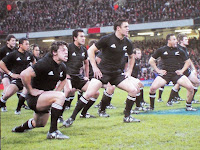
As much as Kiwis love to eat they love sports. In NZ almost everyone is into sports and is part of one or the other team. Kiwis are very competitive, constantly taking part in all sorts of competitions. In NZ you can do any kind of sports, there's really nothing you can't do: Rugby, cricket, netball, water polo, rafting, kayaking, bungy jumping, caving and and and...


- That's a picture of the All Blacks, New Zealand's national rugby union team. If there's a big game on TV, you'll hardly find anyone not watching...It's even bigger than soccer in Austria. On this picture you can see the All Blacks doing the haka, a Maori dance that is perfomed before each international match. To get an idea of what it looks and sounds like check out my video bar!

Kiwis (no, not the fruit and not the animal) - part 1


Today I would like to talk about New Zealanders or rather Kiwis as they generally refer to themselves. At the age of sweet 16 I spent one year as an exchange student in New Zealand. Living with a Kiwi host family and going to the local school gave me a deep insight into their culture and I learned how to live and act like a real Kiwi. This post is not going to be about my ups and downs which I experienced Down Under, but rather about the cultural differences between Austria and NZ. Some of these difference you can see right when you get there - others you can't. You'll have to live there for quite some time and get to know the people in order to notice in what ways they behave differently and then the next step is to understand why they actually do it differently. I think this is going to be a loooooong entry, so I might divide up and make two or three parts. I could write pages and pages about this topic, but don't worry, I'll try to limit myself.. :)

Kiwis in general

On the very first day of my stay in NZ I already realized how unbelievably friendly and open Kiwis are. I was riding on the bus from the airport to my host family when a woman sat next to me and started talking to me. She asked me where I was from, what I was doing here and how much she had heard about Austria. Then she told me everything about the town I was travelling to. In the end she even gave me her number and address in case I wanted to come and visit her. Kiwis are generally very hospitable. It's not a big deal at all to just call in at somebody's place and stay for lunch or even the night. You'll always hear: "Just make yourself at home, will you".

Kiwis are very open, relaxed and easy-going people. Even so, I found it very hard to make real friends. I guess in this respect NZ is similar to the US. People are a bit superficial and it takes very long to make close friends. Especially at college (= high school) it's hard to become part of a group. They already have the cliques and don't need any more friends. So it's up to you to make the effort and try to make friends. The best thing to do is just go and talk to someone and when you hear about a party you'll have to invite yourself. That might sound rude to us, but in NZ it's not. It's the only way to get to know them a little better.

Housing

When it comes to housing you'll find huge differences between NZ and Austria. The first thing I noticed when I was looking out of the window during my busride were those weird looking houses. I didn't really believe that people were actually living in such 'houses' until I got to were I was to spend my next 12 months: a green, rectangular shoe box with sliding doors and windows and walls as thin as cardboard. Oh yes, I loved to hear my host brother snoring at night!! You could really compare their houses with camping trailers. Usually they don't have a second floor and pretty much always there's no central heating. Now you might think that NZ is a warm place where you don't need central heating, but believe me you do!! The climate on the South Island is about the same as in Austria and even though they don't have very cold winters on the North Island you'll often find it much colder inside than outside the house. So what you do when it's getting cold is to curl up by the fireplace in the living room with a couple of blankets and your sheep wool slippers. At night though, the tip of my nose would usually freeze as I slept right next to the window and sometimes I would even feel a chilly breeze blowing in from the closed (!) window. Some beds have electric blankets, but soon I discovered that there was not much use to it: If you forget to turn it off before you go to bed you'll wake in the middle of the night sweating heavily and if you don't, well then you'll wake early in the morning freezing to death. The mornings are actually the worst. Grudgingly you leave your warm bed (after you've heated it up again) and not later than when entering the bathroom you'll be frozen stiff. Kiwis just love to keep their windows open in any room at any time...

I have to mention though, that I can only speak of those living in the country. It might not be quite the same in the big cities such as Auckland, Christchurch and Wellington.

Appearance

Kiwis love to complain about being cold, but it's really no wonder if you see how they dress. No matter which season they always wear shorts, sleeveless shirts and jandals (= sandals or flip flops). And don't be surprised when you see people walking barefoot in the middle of town (and even in the supermarkets) - they even drive their car barefoot. I haven't seen that in the cities though.

If you're in a hurry in the morning and don't have enough time to dry your hair, well no problem: In NZ it's not uncommon to leave the house with wet hair (even in winter of course).

What I thought was really interesting is how Kiwis dress when they go swimming. The common dress code for girls and boys are shorts that usually go way down to your knees. Girls wear their normal bathing suit underneath and boys like to keep their boxer shorts on. Sometimes, and his true, you would see people swimming with their t-shirts still on, even in an indoor swimming pool. Now don't ask me why they are so prude and dress like this. I've thought about it many times and I even asked some Kiwis about this matter, but somehow no one really knows the reason. Maybe it's simply because there are so many overweight girls who are ashamed of exposing their bodies. But it still doesn't explain why everyone is doing it.

Sunday, 15 April 2007

(annoying) Austrian customers

Last time I discussed foreign customers, this time it's going to be all about Austrian customers, especially the most annoying ones. There are actually quite a few different types of them, but what usually distinguishes the Austrians from Germans or other foreigners is that Austrians tend to be more unfriendly and they somehow haven't learned how to greet. Not all of them, that's for sure, but the majority of unfriendly customers is certainly Austrian. Now I'm not too sure why that is the case. Are people from other countries generally more friendly than Austrians? Maybe, but then I also thought that the reason why tourists are so friendly might also be the fact that they are simply tourists. And tourists are usually more relaxed and happy to be on holiday. I'm not too sure about this theory but there might be some truth to it. I guess most Austrians also behave differently when they are on holiday.

Anyway, let me start with my first group: elderly people. We are a good old Styrian restaurant, so we have a lot of elderly people coming, especially at the weekends. Sometimes they come on their own, sometimes it's wife and husband, or, which is also very common, it's two old ladies coming together.
First thing to remember when dealing with old people: speak slowly, clearly and loudly, AND: don't ask any unnecessary questions like "would you like the fried chicken with or without skin?" - it just confuses them. Sometimes you would have to read the menu to them and explain all the meals in detail.
Elderly people are either rather unfriendly, frustrated and complaining all the time, or they are just the opposite: extremely friendly and kind, giving you lots of tips. But the thing with the tips also depends on whether you know how to deal with the elderly or not. Sometimes you would have to listen to the stories about their grandchildren or to these tales that start with "when I was young..." and then there are those who keep rambling on about the war. You have to be careful though and try not to get near them all too often, because one or the other tends to talk for hours.
In order to keep old people content you mustn't forget to bring them all the extras they want: more lemon for the fried chicken, a spoon for almost any kind of meal, more napkins, hot water to warm up their drinks, more milk or sugar for the coffee and at the end don't forget the aluminum foil so that they can rap up what is left. Old people never return plates with leftovers. They either finish it all off, even the last little crumbs (and it often takes them ages to do so), or they take it home. Sometimes you would have to do them an extra favour like sending their meal back into the kitchen to get it pureed (well... I only had that once so far...). Elderly men love to 'flirt' with the waitresses or tell jokes, but unfortunately you don't always understand them. So what you have to do is just pretend you understood and smile or laugh, whatever you feel is appropriate...It usually works ;-)

Let's move on to my absolute specialty: the we-are-better-than-you people (also called 'upper class'). The problem that I occasionally have with these people is that they mistake our restaurant with something like a gourmet restaurant. They always want special extras like linen napkins, which we don't usually have, they are extremely picky about the food and they always find something to complain about ("could you turn off that light, it's so bright" , "could you close that door/window, there's such a draft in here" etc...). It wouldn't be such a big deal if they treated you right, but some really look down on you and treat you with contempt. They consider you the stupid little waitress who completely lacks of education and knowledge of any kind. I really hate that. Some even go so far as to say "Could you please send a waiter to take our orders?" - I might look young, but I still do exactly the same job as the others, and definitely not worse.

Then we have our regular customers - another interesting kind. I really don't know what it is, but you could describe most of them as weirdoes...They keep telling you jokes that are not funny, talk about the strangest things in the strangest ways and sometimes they even look and smell kind of 'special'. Some of them come almost every night and just have a couple of beers, others come every weekend, usually to have lunch. In the beginning it was quite hard for me to deal with these people, since they would get rather grumpy if I didn't bring them the right thing or if I didn't know which drink they usually have and in what kind of glass they always have it (why the hell do they need special glasses?). If I dared to ask which drink they wanted, they would frown at me and say: "I'll have what I always have!" By now I know exactly who gets what, when and in which glass...It's really funny: some don't even have the same drink every week, but also the same meal every single week and most importantly: sit at the same table every time they come. And if that particular one is already taken...well, then you'd better find something immediately to make good for having forgotten to reserve their table (and don't let that happen too often!!) Some of our regular customers are particularly choosey and only want to be served by one particular waiter - some even believe to get a 'special' price by certain waiters, which, of course, is only in their imagination.

A very stressful type are also the I-know-the-owner-of-this-restaurant people, because they really think to be kind of privileged. They always order something that is not on the menu. So when you tell them that "I'm very sorry, but we don't have that" they go "well, last time I had the same thing, why wouldn't it be possible this time? You know, I'm a friend of the owner..." Yeah right, our boss probably doesn't even know that person's full name...But what can I do? It's always going to be me who has the troubles: I have to ask the chef whether he can make an exception and cook something which is not on the menu (he usually gives an annoyed 'yes', but not without complaining about how busy they were in the kitchen) and then I have to ask one of the head waiters what to type into computer concerning the name and price of this special meal...

What also annoys me about Austrian customers is when they...
- are allergic against every single ingredients you could imagine (why go to a restaurant?)
- reserve a table for twelve but only four of them show up
- reserve a table and then only order a salad or soup
- don't read the menu but ask you about all the meals that are in there
- say they are ready to give their orders but when you get there they examine the
whole menu over again
- go straight to the non smoking area, but then complain about not being allowed to smoke...

I have to say though, that there are not only unfriendly, complicated and annoying customers. If it was so, I wouldn't be working as a waitress anymore and I actually really like my job. I come across so many different kinds of people from all walks of life and various countries, which makes me learn a lot about people in general and how to deal with them.

Friday, 13 April 2007

nationmaster.com


Go to www.nationmaster.com and check out thousands of facts about any country in the world, from Afghanistan to Zimbabwe. You can find out about their crime rates, economy, food, lifestyle etc. and also compare the various contries with each other. I spent quite some time at this website, so I would like provide you with some interesting information:

Which do yo think is the most generous country in the world?
The most generous countries are also the richest countries, thus Luxemburg is the number one ($ 496.59 per capita), followed by all the Scandinavian countries. Austria is number 11 ($83.12) and the US are number 20 with $23.12 per capita.

The most dangerous country to live in, when it comes to murders, is Colombia where 0.617 per 1,000 people die. It's followed by South Africa (0,496) and Jamaica (0,324). The US are number 24 (0,042). Unfortunately I couldn't find Austria in this ranking.

The country that attracts the most tourists is France (67,310,000). Next goes the United States with 47,752,000 and Spain with 43,252,000 tourist. At the bottom of the list you'll find Rwanda with only 1.000.

What about the students' attitude towards school?
In Belgium 42 % of all students dislike school. In the US it's 35 % (number 5) and in Austria 29% (number 9). The Scandinavian countries have the happiest students.

The corruptest country of all is supposed to be Chad (which gets only 1.7 out of 10 points). Highly clean of corruption are Iceland (9.7), Finland and New Zealand (both 9.6). Austria, you'll find on rank 10 (8.7) and the US on rank 17 (7.6).

Unfortunately it wasn't hard to guess that the country with the highest obesity rate is the United States with 30.6% of its population being overweight. But then you hear a lot of Britons accusing Americans of obesity, but when you have a look at those statistics you'll find the UK right on number 3 with 23 % (number 2 is Mexico).

What do you think, which is the happiest nation in the world?
It's Venezuela (55%), followed by Nigeria (45%) and Ireland (42%). The US are number 8 (with 39% happy people) and Austria is only number 18 (30%).

And where will you find the most people who are unhappy?
62% of the people in Bulgaria consider themselves as unhappy. You'll find most Slavic countries among the most unhappy nations in the world. Austrians love to complain a lot, but in the end only 9% are truely unhappy. In the US it's 8% of the population.

One more thing: where will you find the oldest brides?
In Sweden a woman's age at her first marriage is on average 30.4 years. Austria is number 12 with the bride's age being about 27.9 years and most American women marry at the age of 25.


Monday, 9 April 2007

customers from all over the world


Working as a waitress in a restaurant you learn a lot about the eating habits, table manners and also the character of people from all over the world. Today I would like to give you a general idea of how people from different nationalities behave in a restaurant. To do so, I will have to make some generalizations. So please don't get me wrong, I know that there are always exceptions and that you can't say that all the people from one country are the same. Still, I have made some observations over the past year, which I would like to share with you.

Let me start with my absolute (non-) favourites: the Italians. First of all: I love Italy and generally I have nothing against Italians. But...having them as customers in a restaurant is a different matter. The problem with the Italians is that we usuallly get them in huge groups, like 50 or even up to 100 of them. A couple of Italians, that's fine with me. Dozens of them - that can be a real pain!! Every other week we get in huge groups of Italian tourists, sometimes we get school classes (and believe me, dealing with twelve year olds is even worse). Italians aren't only the loudest of all but also the most annoying. There are usually two waiters responsible for a group of 50 people, and dealing with such a big group of Italians can really stress you out!! They constantly cry for "acqua, acqua" and "pane, pane", even when you are busy passing out dozens of hot dishes. They can't wait, if they want something they want it right on the spot. Once - I was busy carrying heavy stacks of dirty dishes - an old lady grabbed my arm tightly and yelled: "il bagno, il bagno??". One second later and two steps further toward the door another lady held on to me with exactly the same question...Yeah, I love them!! But don't think that the work is over once you got rid of them!! The Italians are the ones who leave the worst mess behind! I don't even think they have ever heard of the term 'table manners' before. When you come back to clean up, you could as well believe you are entering a battle field: bread, fries, napkins, tooth picks and cutlery cover the floor; table cloths are coloured with tomato sauce, wine stains and with whatever they had for dessert...it usually takes you twice as long to clean up the mess.
If they don't arrive in large hordes but in small numbers, as 'normal' customers, they can be quite acceptable. They tend to eat lots... I would have enough with what they have only for a starter. Usually it's Sauerkraut and sausages, Gulasch or Verhackertbrot. As a main dish they quite often go for the mixed grill and they pretty much always have bread with everything. Oh, and don't forget the espresso!

The Japanese are just about the opposite of the Italians. They are veeeeeery quiet, polite and friendly, and they keep smiling all the time. What a lovely people!!! And so easy to handle. They usually eat Gulasch or Bauernschmaus but don't eat more than half of the portion, cause they just can't fit it in. And they love black currant juice. There's only one strange thing about the Japanese. Whenever we have a group of about 20, the whole room fills with a 'special' smell. I really don't know what it is, and maybe I don't even want to know, but they do smell rather strange...

There's not really much I can tell you about the French. But one thing is true: communicating with French people is almost impossible. Most of them refuse to use any other language than their own and they just don't get that I don't understand them in their mother tongue. There's no point in telling them "I don't speak French". They just keep talking and talking...That's why I try to avoid taking their orders, cause I usually end up serving them things they didn't order :-)

I can't think of any other nation that is as friendly as the English. Almost every single sentence contains a "thank you", "oh, that's wonderful" or "how lovely". And they definitely know how to say hello and good bye (which is something the Austrians dread to do).

Then we have the Russians. Hmm...actually, sometimes they scare me a little. I don't really know why though, probably because they seem to be very serious people who don't laugh a lot And: usually they appear in groups of only men...But Russians are very generous customers, leaving lots of money. They spend quite a lot on alcohol, especially vodka and expensive wine. The other day we had some Russians who ordered two bottles of our finest wines, but only drank about a quarter of each. Me and my two workmates had a pretty good time after closing hour... good wine can't be wasted ;-)

Last but not least: the Germans. They still manage to crack me up by ordering "ne Apfelschorle" or even better "ne Weinschorle". And quite often you have to translate Erdäpfel, Topfenknödel and Eierschwammerl into 'proper German'. One more thing you have to know about Germans as a waitress: when they order water, they usually want sparkling water. So don't get them just tap water.

Generally, Germans are pretty friendly, unlike most of the Austrians. But that's a different story... Next time I'll write about the different types of Austrian customers. Some of them make me hit the roof...


Friday, 30 March 2007

Americans, Americans...

I just watched "Voices from the Mother Country" and "Americans are NOT stupid" In case you haven't seen it yet, go watch it!! It's really funny, especially the second one.
In the first video clip poeple are asked to describe what Americans are like. The people interviewed, mainly Britons, all had similar opinions of Americans. More than one said that they were loud, pushy, over-powering, brash and (over-) confident but also friendly, pleasant, generous and hospital. They all came to the conclusion that Americans aren't very inhibited but say what's on their mind.
The second vidio clip is much more entertaining. An Aussie wants to prove how stupid Americans are and that they don't know anything about the world. So he goes around and asks questions like "what's the religion of Israel?", "Kofi Anan is a coffee, true or false?" or "how many sides has a triangle?" It's obvious that he only interviewed the most stupid people and then only showed those who didn't have a clue of anything at all. But still, let me tell you something you surely didn't know before:
- The religion of Israel is Israeli
- Fidel Castro is a singer
- A triangle has no sides
- The currency of the UK is American money
- Italy and Canada should be invaded in terms of the war on terror
- Tony Blair is a skater
- Florida, NY and a couple of other US states are in the axis of evil
- a mosque is an animal
- Star Wars is based on a true story
- and Al Quada is a suicide group whose president is Yasser Arafat
there are always new things to learn, aren't there...
But let's face it, you could make a fool of any people in the world and make a video clip like that. No matter where you go, you'll always find some stupid people who don't know anything about the world, which is rather shocking but the truth.